

Archive for the ‘Interviews’ Category
European Court of Human Rights: Italy under the scrutiny of the Court
The European Court of Human Rights (ECHR) has protected human rights across the continent by interpreting and applying in its judgments the European Convention on Human Rights and Fundamental Freedoms.
The Court protects the rights of 800 million people in 47 countries. The number of pending applications before the Court has constantly grown. Whereas in 1999 8,400 applications were allocated to a judge committee or chamber, this figure rose to 27,200 in 2003, when around 65,000 applications were already pending. In 2009 57,200 applications were allocated to a judicial formation and the backlog reached 119,300 applications.
To better understand the existing relationship between Italy and the European Court we have interviewed Antonio Giulio Lana, chairman of ECHR (European Court of Human Rights) who affirms that: “Italy has been under the European Court’s scrutiny for a long time for violating Art 3 of the Convention (Prohibition of torture: “No one shall be subjected to torture or to inhuman or degrading treatment or punishment)”.
Dr. Lana, can you explain?
Art 3 refers, among other things, to prison conditions. For example, it refers to prison overpopulation that, in some cases, can lead to ‘degrading treatment’. In particular, in 2009 the European Court ruled that Italy should pay Izet Suljmanovic, a Bosnian man, 1,000 euro in compensation for cramped conditions while he was in jail for theft. The reason? Sulejmanovic was detained in two cells of 2.7 and 3.5 meters each. This condition was considered ‘degrading’ by the Court. This ruling set a precedent: too many prisoners cannot be kept in small, overcrowded cells with indecent toilet services.
Lana, does that mean that a lot of people will appeal?
Theoretically yes. Especially those prisoners who live in degrading conditions similar to those endured by Sulejmanovic. We know that this regards the majority of Italian inmates. Unfortunately, we also need to add that the European Court is victim of its own success as appeals have grown exponentially and it now takes three or four years to get a ruling. Many lawyers do not have the mentality to fight such battles.
However, now inmates have reached almost 70,000, a record number in the history of the Republic.
Exactly. Thousands of people could appeal. I would like to specify that I’m not against this government but against all governments that have not dealt with this issue properly over the years. The administration of Justice in Italy is slow, this is the point. To speed things up we should hire new clerks, secretaries and judges and also buy new computers. Instead we pass more and more laws. Whoever gets the power makes new laws as if we had not enough already. I say: we need less laws and more resources. Otherwise it will all become a mockery.
The excessive use of preventive incarceration is due to this?
In a way, it’s a consequence. I am not saying that it’s always like this. I’m just saying that too often we have seen an excessive use of preventive incarceration and a distortion of its mechanisms.
Remand in Custody: Stop the abuse. A bomb is about to go off
The attorney Giandomenico Caiazza, chairman of the Criminal Chamber of Rome, sounds the warning bell over prison overpopulation and announces that some ‘concrete action’ to solve this issue will be discussed in a conference that will be held in the capital on June 17. On Scaglia’s case he adds: “We cannot understand why someone who made himself available to the judicial authorities should be treated this way”.
Attorney Caiazza, what is Italy’s current prison population?
We do not know the exact figure but what we know is that prison population is over 68.500 for the first time in the history of the Italian Republic. It’s a bomb that might go off at any time as the situation has reached the limit. Every month 1000 people go to jail and only 400 go out. Prison directors are desperate as they do not know which way to turn anymore.
In other words, is this an emergency?
When pardons were granted in 2008, almost 20.000 prisoners were released and prison population dropped from 60.000 to 40.000. Two years later we are back to square one, if not worse. Prison population has grown by 8.000. The intended capacity of all Italian detention houses is 45.000 though prisons can house up to 63.000 inmates. In the meantime, none of the prisons that needed to be built have been built yet. Then, you find out that in some detention houses like Fuorni in Salerno there is a whole floor with empty cells as the prison is understaffed.
How many remands in custody are issued? That is, how many prisoners awaiting trial are there?
The remand in custody concerns 26.000 subjects, that is, 40% of prisoners. There has been and there still is an improper use of the remand in custody. The legal system has over the last 20 years changed its function to the point of distorting it: from a custody measure it has become a social deterrent.
But don’t you need serious evidence of guilt?
Of course. However, the concept of serious evidence of guilt has also changed. The law is clear about it: I can keep you in prison if there is danger of escape, of tampering with evidence or of repeating the crime. The law is fair. However, the way the law is enforced has totally changed. A lot of speculations are often made about the chance that someone could repeat the crime as prison time for the danger of tampering with evidence (the other pre-condition for preventive incarceration) is set by law. In other words, according to the law if you hold someone in prison because they can tamper with evidence you should set their jail time, whereas if they can repeat the crime you can keep them in prison for longer. Many magistrates cover things up when they have no concrete evidence. Some Courts of Justice and Cassation support this behaviour.
So what can be done?
One of the proposals we will discuss during the conference is this: as for the danger of repeating the crime, house arrest should be granted with few exceptions if needed, as long as these exceptions do not become the rule. Otherwise the remand in custody becomes a punishment before the case has even been heard in court.
What do you think of Scaglia’s case?
It’s a classical example of what I just said. It’s not clear why such an extreme form of preventive incarceration was implemented since the subject had made himself available to the judicial authorities. I believe that in Silvio Scaglia’s case a pattern and practice that go beyond the constitution have been enforced, as incarceration has not been used as the last resource but as the ultimate solution. And no reason for it has been provided either.
‘Terrible and unintelligible’: Silvio.scaglia.it interviews Franco Debenedetti
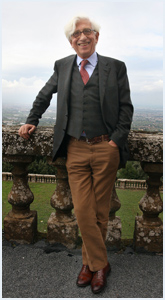
Senator Debenedetti, 73 days have passed since Scaglia’s arrest. How do you feel about this use of preventive incarceration?
“I feel that something terrible and unintelligible is happening. This generates fear”.
Franco Debenedetti, an experienced manager who has been elected to the Senate in the listings of the PDS and PD for three terms, was among the first to bring up the issue of Scaglia’s judicial treatment in “Il Sole 24 Ore” of 28 March.
“It is not clear why he is still in prison. There is no danger of him running away. He was in Brazil and came back to Italy spontaneously. He cannot repeat the crime: he has not played any operational role at Fastweb in years. He cannot tamper with evidence, given that after so many months evidence has already been gathered. He cannot influence witnesses whose statements have already been collected”.
Senator, most of these questions had already been raised in your intervention back in March. Did you get an answer?
“No I didn’t, I’m afraid. I understand that they don’t owe me an answer but is it good to leave the public in such bewilderment? My only explanation is that Scaglia is still in prison because “he would not show signs of repentance”. I can hardly believe that: do we live in a secular state governed by the law or have we gone back to the Spanish Inquisition when torture was used to get a confession?”
It’s something that goes beyond human solidarity for a presumed criminal, isn’t it?
“Yes. If Scaglia’s rights have been violated, our rights have been violated too. We are entitled to believe that the judiciary system protects us. When we don’t understand, when doubts rise, mistrust and fear come into place. I wonder if we realize how serious this is”.
Silvio Scaglia? In the US he would be free

If Silvio Scaglia had lived in the US, he would have been free. He would not be in jail now and would have not had troubles with the law.
Alessandro Bernasconi, Lecturer in Criminal Law at the University of Brescia, does not like to generalize, especially when it comes to criminal law. In the US a public prosecutor would have never re-opened a case that had already been dismissed once due to lack of evidence. And even if he had done so, Silvio Scaglia would have gone home within a week.
Prof. Bernasconi, what would have American prosecutors’ behavior been about Scaglia’s case?
“The Common Law system is very discretionary and the so-called ‘double jeopardy’ does not allow prosecutors to pursue somebody for the same crime more than once. This ensures stronger guarantees compared with the ‘no bis in ibidem’ principle of the Italian system. Since the case has been dismissed once, hardly anybody would have re-opened the inquiry.
And if somebody insisted on re-opening the case?
“Investigations in the US are the first step towards building a career in politics and very few people would have wasted their time on a case that had already been dismissed. If that had happened, maybe they would have arrested him but certainly he would have not been detained for so long”.
Can you explain that further please?
“If the detained person makes himself available to the prosecutors and offers ample explanations, he is released straight away. If he does not give any explanations he can be released on bail. This is not reserved to the rich only but it is accessible to everyone thanks to the existence of suitable insurance companies. There would have hardly ever been a trial: in the US an agreement between the parties is always encouraged.
Let’s get back to Europe: Scaglia’s case in the UK…
“The British legal system is similar to the American one and a case that was dismissed once would hardly ever be reopened. Having said that, if the prosecutor believes that a serious crime has been committed he can request a preventive custody order but he would need to produce unequivocal evidence of guilt”.
How long does preventive incarceration last?
“The evidence is examined by the judge within 2-3 days. The judge’s decision is heavily influenced by whether the indicted person represents a danger to society or not. Certainly, the British legal system does not allow for an improper use of justice: the British judiciary system would not allow a prolonged detention aimed at getting a confession but…
But what?
Distinctions need to be made cum grano salis. Every case is different, has its nuances. We cannot make simplistic parallels between various legal systems. Let’s think of the abuses that took place in England in the 70s to fight the Northern Irish terrorism.
Let’s go back to the continent. In France and in Germany would Scaglia still be in prison?
The “continental” legal systems are similar and both the French and German systems are close to the Italian one as far as preventive custody is concerned.
What are the differences?
In France there is the ‘opportunity to pursue’ and prosecutors report to the Ministry of Justice, that is, to a politician. In Germany the legal system is discretionary only for certain crimes and there is no public prosecutor as such, as police officers act as public prosecutors. It depends. Surely, the chances of putting an end to an inquiry that has already been dismissed once are higher there than in Italy.
Silvioscaglia.it interviews Pier Luigi Celli

“Silvio has always been very rigorous, to a nearly unconditional Calvinistic extent. He never dared anything that would not fall well within the rules. I can hardly imagine Mr. Scaglia behaving incorrectly not to talk about a criminal conduct”, quotes Pierluigi Celli, the present general manager at Luiss University in Rome, with a top-manager background in the industrial and the finance sectors. Celli is the same man who hired Silvio Scaglia at the beginning of the Omnitel enterprise.
Dottor Celli, today Silvio Scaglia “celebrates” his 67 days of preventive incarceration. Without mentioning the merits of the inquiry, what are the feelings one could have for these inquiry methods?
“This situation is not acceptable. Without even mentioning the merits of this inquiry – for which I have my own personal feelings – I believe that such a long incarceration term is not explicable. Silvio Scaglia is not a gangster: he is a citizen who was out of the country and could have stayed there but decided to come back to Italy as soon as possible and collaborate with the judges as any good citizen would have done. But a punishment that does not make sense has been inflicted on him”.
It’s a punishment that infringes his constitutional rights that are the same as human rights, isn’t it?
“I do not understand this system. If there is enough evidence to determine someone’s faults then he should be brought to court and sentenced. But you cannot keep a human being in jail, no matter what he did, thinking that sooner or later he will confess his crime. And if this is true at a purely conceptual level, I must add that talking about Silvio, I do have my personal opinion for what it’s worth: again, I cannot even conceive any action of himself that is not at least abiding the rules”.
In the past few days the President of the Republic, Giorgio Napolitano, has stressed that a judge must be ”fair and controlled”. Maybe that’s not the way things went for Scaglia.
“Giving an opinion on judges and their acting is definitely a difficult task. Justice is a very hard and challenging job. But I believe that fairness is a crucial quality in dispensing justice. What is not fair cannot be right. So, I can hardly understand the approach taken to Scaglia’s case. Actually, I fear these are exactly the kind of actions that are most detrimental to the essential task of the judges. I am not a biased person who blames judges by prejudice. I rather always thought that one needs to help a judge as much as possible. However, I must say that this affair really troubles me”.
Why, in your opinion, can’t Italy reach a fair compromise between the requirements of the investigating authorities and the lawful rights of the investigated parties? Why can’t we find the balance mentioned by Napolitano?
“Because the judges have been assigned a substitute role due to the disaster we are living in. In the long term one may start feeling like a country hero. But the country needs no heroes, just people who like to do their job and do it well”.
In your opinion what was Scaglia‘s case impact abroad?
“People who know Silvio were stupefied, astonished and incredulous. I received a lot of calls. They were all upset for the way he got treated: Silvio is a businessman who created, not destroyed, a large wealth. He even acted correctly by helping the judges. For this reason alone, he deserves respect”.
Judging from the tones of certain interventions, especially during the first few days, it seems as if they wanted to punish him because of his business luck.
“Each one of us has seven deadly sins. I always say that it is better to have the ones that will make you feel good. However, in Italy jealousy and envy are the most widespread sins and the ones that make you feel the worse”.
It is a country where the voice of the defenders of civil liberties is weak. After the fanfare of the first day, a sort of silent curtain fell. Yet, Scaglia’s imprisonment term cries revenge each day that passes, doesn’t it?
“Italy is a short minded country, that appeases when it is more convenient. People aren‘t permanent indignant. However, there is another explanation”.
Which one?
“One could say that the more you hide your indignation, the less you bother the decision-makers”.
But it did not work.
“No, unfortunately it did not. Scaglia’s case is a scandal that needs to be brought to light to avoid this from happening again. There are limits that need to be safeguarded for everyone’s sake”
So?
“So this sort of therapeutic treatment against Silvio must come to a stop”.